

What did your oncologist say when you asked about HRT?
And did you get a clear answer?
For many breast cancer survivors, menopause brings a new set of challenges.
Hot flashes. Night sweats. Poor sleep. Vaginal dryness. Pain during sex. Mood changes.
And sometimes, these symptoms can start suddenly because of cancer treatment.
You’ve already been through so much.
You shouldn’t have to feel like you can’t ask about what happens next.
Menopause After Breast Cancer Can Be Different
Some breast cancer treatments can cause menopause or make menopause symptoms worse.
You may notice:
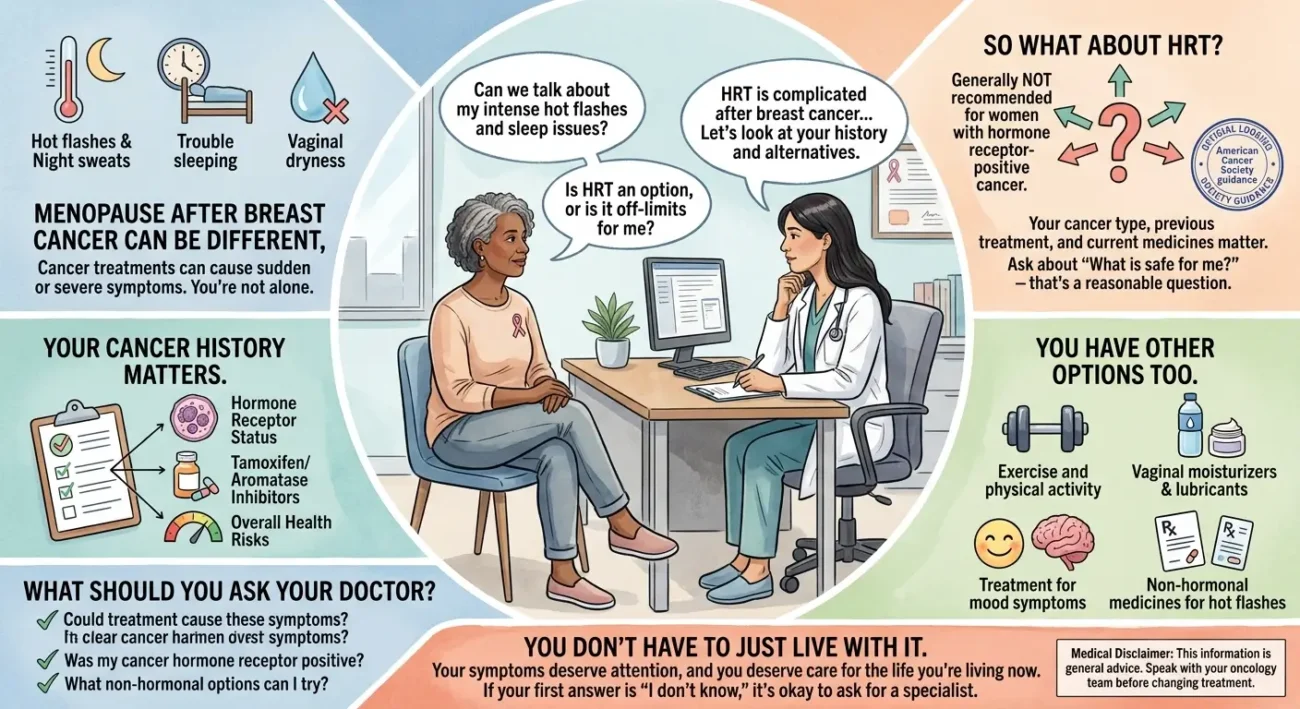
- Hot flashes and night sweats
- Trouble sleeping
- Vaginal dryness
- Pain during sex
- Mood changes
- Joint or muscle discomfort
- Changes in sexual desire
These symptoms can affect more than your body.
They can affect your sleep, relationships, work and overall quality of life.
So What About HRT?
This is where things can get confusing.
You may hear that HRT is completely off limits after breast cancer.
But you may also hear someone say it’s safe.
The answer isn’t that simple.
Menopausal hormone therapy is generally not recommended for women who have had breast cancer, particularly those with hormone receptor positive cancer. Your cancer type, previous treatment and current medicines all matter. American Cancer Society guidance on HRT after breast cancer
So asking about HRT doesn’t mean you have decided to take it.
You’re asking:
“What is safe for me?”
That’s a reasonable question.
Your Cancer History Matters
Your doctor may look at:
- Whether your cancer was hormone receptor positive
- The treatment you received
- Whether you’re taking tamoxifen or an aromatase inhibitor
- How severe your symptoms are
- Your other health risks
- Whether non-hormonal treatments have helped
That’s why advice from a friend, social media post or online forum isn’t enough.
Your treatment needs to fit your medical history.
You Have Other Options Too
HRT isn’t the only way to manage menopause symptoms.
Depending on your symptoms, your healthcare team may discuss:
- Non-hormonal medicines for hot flashes
- Vaginal moisturizers and lubricants
- Sleep support
- Pelvic health treatment
- Exercise and physical activity
- Treatment for mood symptoms
The right option depends on what you’re dealing with and what cancer treatment you’ve had.
What About Vaginal Estrogen?
This question comes up often.
Vaginal estrogen is different from systemic HRT because it is used locally for symptoms such as vaginal dryness and irritation.
Some research suggests low-dose vaginal estrogen may be an option for certain breast cancer survivors, but the decision should still be made with your healthcare team. Extra care may be needed for women taking aromatase inhibitors. PubMed research on vaginal estrogen after breast cancer
Don’t start it on your own.
Ask your oncologist what makes sense for you.
What Should You Ask Your Doctor?
If you’re not sure where to start, write down a few questions before your appointment.
“Could my cancer treatment be causing these symptoms?”
“Was my cancer hormone receptor positive?”
“What non-hormonal options can I try?”
“Would a menopause specialist help me?”
“Are there treatments that are safe with my current cancer medicine?”
These questions can make the conversation much easier.
You Don’t Have to Just Live With It
There’s a common idea that after breast cancer, menopause symptoms are simply something you have to tolerate.
That’s not the goal.
Not every treatment will be right for every survivor.
But your symptoms still deserve attention.
If you’re not sleeping, say so.
If sex has become painful, talk about it.
If hot flashes are affecting your daily life, bring them up.
You survived cancer.
You deserve care for the life you’re living now, too.
And if your first answer is simply “I don’t know,” it’s okay to ask whether another qualified specialist can help.
Medical Disclaimer
This article is for general information and isn’t a substitute for personal medical advice. Breast cancer survivors should speak with their oncology team before starting, stopping or changing hormone or menopause treatment.
References
- American Cancer Society. Menopausal Hormone Therapy After Breast Cancer.
- Beste MA, Kaunitz AM, McKinney JA, Sanchez-Ramos L. Vaginal estrogen use in breast cancer survivors: a systematic review and meta-analysis. American Journal of Obstetrics and Gynecology. 2025.
- Baquedano Mainar L, et al. Safety of vaginal estrogen in breast cancer survivors: Current evidence on systemic absorption and oncologic outcomes. Maturitas. 2026.
- American Cancer Society. Hormone Therapy for Breast Cancer.


