

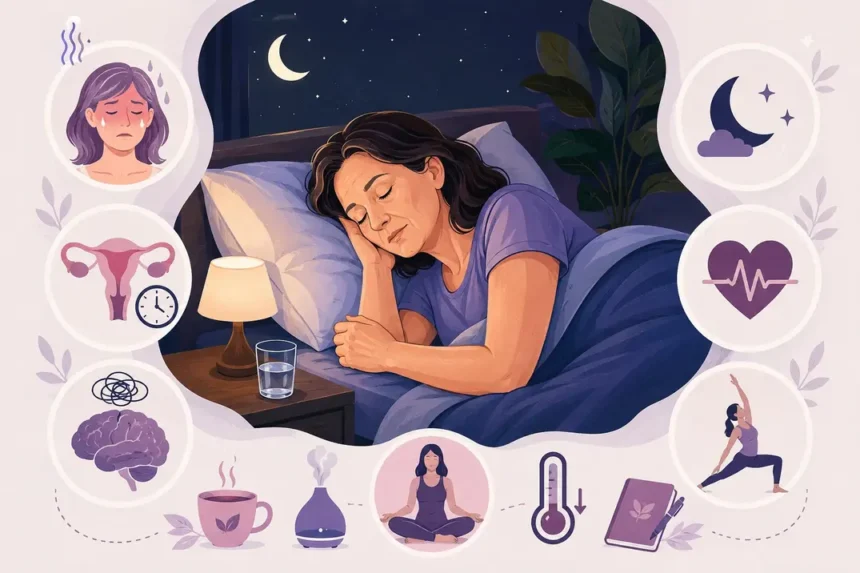
Sleep can feel very different during perimenopause and menopause.
You may fall asleep normally but wake up at 2 a.m.
You may wake up hot, throw the covers off, cool down, and then struggle to fall asleep again.
Or you may sleep for what feels like enough hours but still wake up tired.
And then the day starts.
You feel more hungry.
Your energy is lower.
Your mood feels different.
You just do not feel quite like yourself.
And it is not just in your head.
Why Sleep Can Change During Menopause
As estrogen and progesterone change during the menopausal transition, sleep can become more difficult. Hot flashes and night sweats can also wake you during the night. Research shows that menopause-related sleep problems can have more than one cause.
You may notice:
- Waking several times
- Night sweats
- Feeling too hot in bed
- Waking earlier than usual
- Trouble falling back asleep
- Feeling tired the next morning
So if your sleep feels different lately, there may be a reason for it.
When Night Sweats Break Your Sleep
A hot flash may only last a short time.
But waking up can leave you fully awake for much longer.
You may:
- Throw off the covers
- Change your sleepwear
- Get some water
- Check the time
- Start thinking about tomorrow
And suddenly, you are wide awake.
If this happens often, try keeping your bedroom comfortable and cool, with lighter bedding and sleepwear that works for you.
Small changes can make those wake-ups easier.
When Poor Sleep Starts Affecting Your Day
When sleep suffers, so does everything else.
You may notice:
- Less energy
- More irritability
- Trouble focusing
- Less motivation to exercise
- More hunger or cravings
- Feeling tired even after getting out of bed
It can become a cycle.
Poor sleep → low energy → harder days → more stress → another difficult night.
Which is why sleep matters so much during this phase.
Not because you need perfect sleep.
Because your body needs recovery too.
A Few Things That May Help
You do not need a perfect bedtime routine.
Start with the basics:
- Keep your wake-up time fairly consistent.
- Keep your bedroom comfortable and cool.
- Notice whether caffeine later in the day affects you.
- Notice whether alcohol changes your sleep.
- Give yourself some quiet time before bed.
- Stay active during the day.
- Try not to keep checking the clock when you wake up.
You do not need to change everything at once.
Pick one or two things and see what works for you.
What If You Wake Up at 2 a.m.?
Try not to turn one wake-up into a battle.
Keep the lights low.
Avoid reaching for your phone if you can.
Get comfortable.
Cool down if you are hot.
Give your body a chance to settle.
If you stay awake for a long time, getting out of bed and doing something quiet until you feel sleepy may be better than lying there frustrated.
And if this keeps happening, you do not have to figure it out alone.
Do Not Assume Every Sleep Problem Is Menopause
Menopause can affect sleep, but other things can too.
Speak with a healthcare professional if you regularly have:
- Loud snoring
- Gasping or choking during sleep
- Severe daytime sleepiness
- Ongoing insomnia
- Restless or uncomfortable legs at night
- Sleep problems that are affecting your daily life
The goal is not just to blame hormones.
The goal is to understand what is actually keeping you awake.
What About Treatment?
There are treatments that can help, depending on what is causing the sleep problem.
For ongoing insomnia, cognitive behavioral therapy for insomnia, or CBT-I, has been shown to improve sleep in menopausal women.
Hormone therapy may also improve sleep for some women, particularly when hot flashes and night sweats are part of the problem. But it is not right for everyone.
Your healthcare professional can help you decide what makes sense for you.
Start Paying Attention to the Pattern
If your sleep has changed, keep a simple note for a few days.
| Notice | Example |
|---|---|
| Wake-ups | 2 times |
| Night sweats | Yes |
| Time awake | 30 minutes |
| Caffeine | Before noon |
| Exercise | Evening walk |
| Morning energy | Low |
You are not trying to create a perfect sleep diary.
You are looking for patterns.
That information can also make it easier to explain what is happening to your healthcare professional.
Sleep Is Not Optional During Menopause
You do not need perfect sleep.
You do not need another complicated routine.
And you do not need to compare your sleep with someone else’s.
But if your sleep feels different lately, pay attention.
Maybe it is night sweats.
Maybe it is waking too early.
Maybe your mind will not switch off.
Maybe you are sleeping but still waking exhausted.
There may be a reason for it.
Your body is going through a real transition.
And recovery matters now more than ever.
Sleep is not a luxury during menopause. It is part of taking care of yourself. 💕
Medical Disclaimer
This article is for general health information only and does not replace medical advice, diagnosis, or treatment. Menopause-related sleep problems can have different causes, and treatment should be based on your individual symptoms and health history. If sleep problems continue, become severe, or affect your daily life, speak with a qualified healthcare professional.
References
- Haufe A, Baker FC, Leeners B. The role of ovarian hormones in the pathophysiology of perimenopausal sleep disturbances: A systematic review. Sleep Medicine Reviews. 2022;66:101710. doi:10.1016/j.smrv.2022.101710.
- Lam CM, Hernandez-Galan L, Mbuagbaw L, et al. Behavioral interventions for improving sleep outcomes in menopausal women: A systematic review and meta-analysis. Menopause. 2022;29(10):1210-1221. doi:10.1097/GME.0000000000002051.
- Ntikoudi A, Owens DA, Spyrou A, et al. The Effectiveness of Cognitive Behavioral Therapy on Insomnia Severity Among Menopausal Women: A Scoping Review. Life. 2024;14(11):1405. doi:10.3390/life14111405.
- Pan Z, Wen S, Qiao X, et al. Different regimens of menopausal hormone therapy for improving sleep quality: A systematic review and meta-analysis. Menopause. 2022;29(5):627-635. doi:10.1097/GME.0000000000001945.
- Carmona NE, Starick E, Millett GE, et al. Sleep effects of psychological therapies for menopausal symptoms in women with hot flashes and night sweats: A systematic review. Post Reproductive Health. 2024;30(3):166-181. doi:10.1177/20533691241246365.