

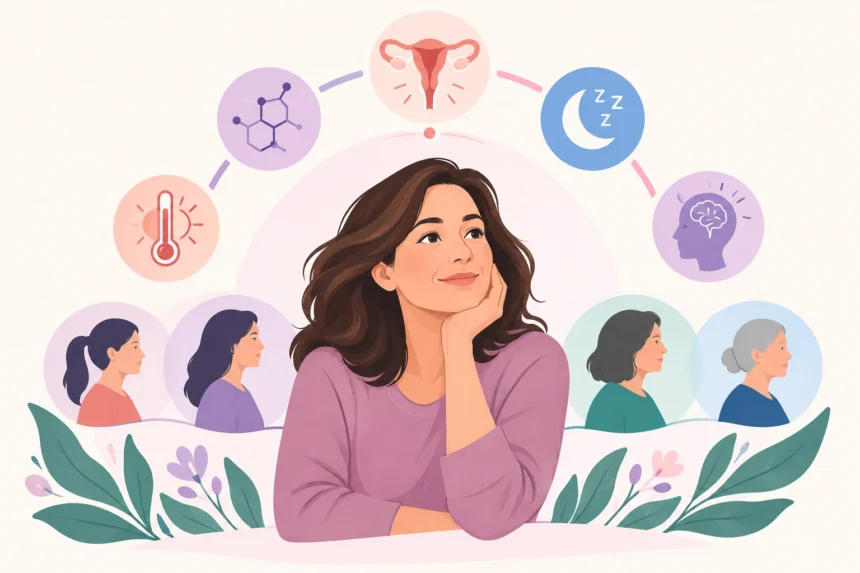
Perimenopause can feel overwhelming when you first start noticing changes in your body.
Your periods may become less predictable. Your sleep may change. You may notice hot flashes, mood changes, or simply feel different from the woman you were a few years ago.
But perimenopause is not something to fear.
It is a natural stage of life, just like puberty was. The more you understand what is happening, the less frightening those changes can feel.
Understanding What Your Body Is Going Through

Perimenopause is the transition before menopause, when hormone levels begin to change and your menstrual cycle may become less predictable.
For some women, the changes are mild. For others, they can affect sleep, energy, mood, comfort, and everyday life.
There is no single way to experience perimenopause.
Your experience is yours.
Do Not Let Social Media Make It Scarier
There is so much information about perimenopause online.
One person says you should worry about every symptom. Another makes it sound like everything will suddenly change overnight.
It can become overwhelming very quickly.
But you do not need to understand everything at once.
Learn about the changes that are actually happening to you. Write down symptoms that keep coming back. Ask questions when something does not feel right.
Knowledge can replace a lot of the fear that comes from not knowing what is happening.
Take Care of Your Health Along the Way
Perimenopause is also a good time to pay more attention to your overall health.
This does not mean trying to fix every part of yourself.
It means giving your body what it needs.
Good sleep, regular movement, nutritious food, stress management, routine healthcare, and time for yourself all matter.
Small things count too.
A daily walk. A better bedtime routine. Making time for an appointment you have been putting off. Saying no when you need to rest.
You do not have to change your whole life overnight.
Give Yourself Some Grace
This part is easy to forget.
Your body is changing, and sometimes you may not recognize yourself for a while.
You may have days when you feel confident and energetic and other days when you feel tired, uncomfortable, or simply not yourself.
That does not mean you are failing.
You are going through a transition.
Give yourself the same patience you would give a friend going through the same thing.
Talk About What You Are Experiencing
One of the hardest parts of perimenopause can be feeling like you are the only one going through it.
You are not.
Talk to your friends. Talk to your partner. Talk to other women. Most importantly, talk to your healthcare provider when symptoms are affecting your life or you are unsure about a change.
There is no need to quietly accept symptoms that are making everyday life harder.
Asking for help is not weakness.
It is part of looking after yourself.
You Are Still You
Perimenopause may change some things, but it does not take away who you are.
You are still allowed to feel confident.
You are still allowed to care about your appearance.
You are still allowed to have goals, make plans, fall in love, start something new, and enjoy your life.
Getting older is not something we need to apologize for.
It is another part of life.
And there is a lot of life ahead.
What I Want More Women to Know
Perimenopause is not a deadline.
It is not a disease.
And it is not something you need to be ashamed of.
The more we talk about it openly, the easier it becomes for women to understand their bodies and ask for the care they need.
So learn what you can.
Look after your health.
Ask questions.
And give yourself some grace while your body finds its new rhythm.
You do not have to fear a stage of life you can learn to understand.
Medical Disclaimer
This article is for general health and educational purposes only and does not replace medical advice, diagnosis, or treatment. Perimenopause can affect women differently, and symptoms may have causes unrelated to hormonal changes. Speak with your healthcare provider about new, severe, or persistent symptoms and your individual healthcare needs.
References
- National Institute on Aging. What Is Menopause?
- Office on Women’s Health. Menopause and Menopause Symptoms.
- The North American Menopause Society. Menopause Transition and Perimenopause.
- American College of Obstetricians and Gynecologists. The Menopause Years.
- World Health Organization. Menopause.